

I was introduced to computers in 1965, and (outside time in the Peace Corps, Nepal) have worked & played with them, and helped others use them, ever since. The first computer I used, a Bendix G-15, was old in 1965. It was off in a corner of the local University’s computer center, away from the newer IBM 1620 and newest CDC 9300 computers. Near the G-15 were some of analog computers, not yet fully obsolete. They solved problems through modeling differential equations with electronic circuits. A particular arrangement of circuits might represent, for instance, some chemical reactions. The CDC 9300 was a hybrid (last or near-last of its kind) in being able to incorporate analog circuitry along with a digital computer. Its FORTRAN IV compiler was a step up from the FORTRAN II on the IBM 1620. (FORTRAN and COBOL were the first two widely used “high level programming languages”.)
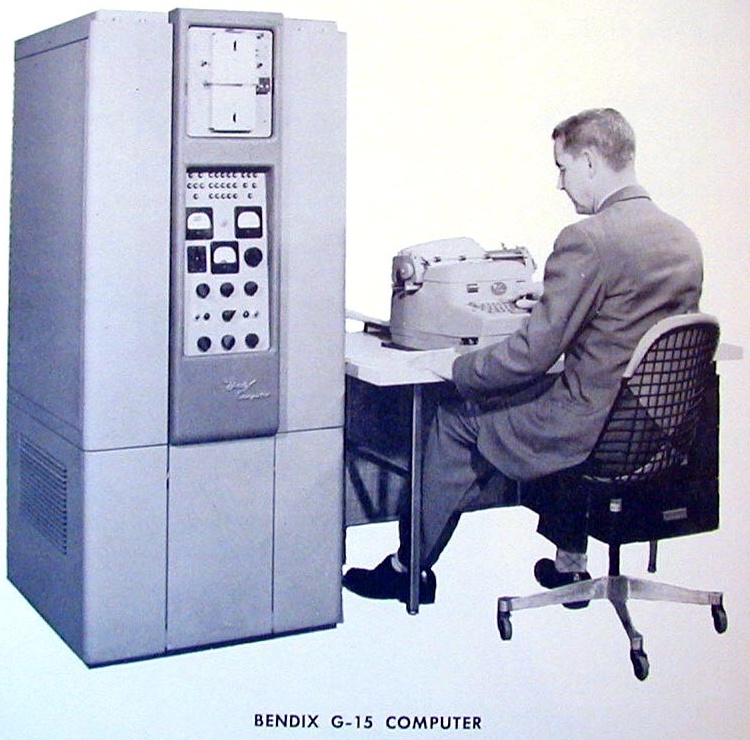
Entering a program for the older G-15 was a matter of typing it onto paper tape on a teletype, then feeding the tape into the computer (tape cartridge can be seen in the top panel of the computer pictured above, held in place by the handle across its middle). The cabinet held lots of vacuum tubes (called valves in the UK), for those who remember them. The main memory was not today’s semiconductor RAM, nor the earlier core (magnetic donuts) memory. It used a rotating drum to hold programs – so hot-shot programmers would place consecutive instructions at an interval apart on the drum so that when one instruction had been completed the next would be just about to come under the read head, all lined up to be read, interpreted, and executed as quickly as possible, rather than waiting an average of 1/2 a rotation of the drum for the next instruction to be available.
I wrote programs in FORTRAN for a small civil engineering company for many years. I maintained & extended both a basic accounting system set up by IBM and the COGO (COordinate GeOmetry) program used by the engineers. I did the legwork to move them from an IBM 1130 to a DEC PDP 11/40 computer running RSX-11D, an early multi-user operating system. The latter never reached its full potential because the computer didn’t have enough RAM (which was quite expensive at the time) to handle multiple users.
I was lured from civil engineering by a “jack of all trades” position at the local university’s (DE, USA) College of Education (from wiring circuits for experimental data gathering to managing a lightly used unix system to working on an Old English Concordance to using the PLATO system). I moved from there to the university’s central computer support organization to be the first person specifically supporting the newly-introduced IBM PC, followed by adding the Apple Macintosh, and later other PCs.
Since moving to Vermont in 1998, I’ve done a variety of computer-related work. Now retired, I do some work with web sites – mine and others I’ve helped create and manage. I make light use of FB, and don’t use instagram, twitter/x, or most of the other popular [apps/channels/?]. I’ve become quite engaged in a few Mighty Networks based communities.